


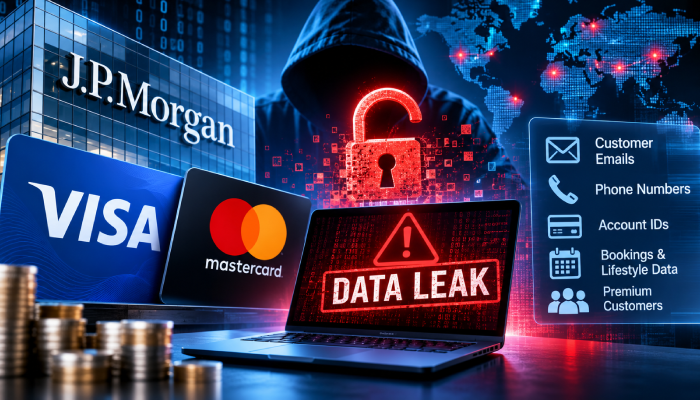
The ransomware group n0n’s alleged data leaks involving three global financial brands expose a growing vulnerability in the financial services ecosystem. From approximately 16,000 JPMorgan Reserve-related customer records to premium Visa customer information, the incidents highlight how third-party marketing platforms and fragmented data environments can create lucrative opportunities for cybercriminals.
The global financial services industry has invested billions of dollars in cybersecurity, fraud detection, identity protection and regulatory compliance. Banks and payment networks operate sophisticated security infrastructures designed to protect transactions, customer accounts and financial information. Yet a new series of alleged data leaks involving JPMorgan Chase, Visa and Mastercard demonstrates that the most valuable information in the financial ecosystem may not always be found inside core banking systems.
Instead, it may reside in customer engagement platforms, marketing databases, reservation systems and external technology environments connected to financial institutions.
The ransomware group n0n has published datasets it claims are associated with the three financial brands. An investigation by Cybernews researchers has identified approximately 16,000 customer email addresses linked to JPMorgan’s Reserve programme, more than 6,000 premium Visa customer records and approximately 2,000 entries in a dataset allegedly associated with Mastercard.
The three exposures differ considerably in size, sensitivity and apparent authenticity. However, together they illustrate a critical cybersecurity challenge: financial institutions must protect not only the money they manage and the transactions they process, but also the extensive personal intelligence generated through their customer relationships.
“Financial data breaches are no longer just about stolen credit card numbers. The exposure of customer identities, contact details, banking relationships and lifestyle information can give cybercriminals the intelligence they need to target some of the wealthiest individuals in the world.”
For high-value customers, that information can become particularly attractive to criminals.
JPMorgan: When customer identity becomes a high-value target
The JPMorgan dataset is particularly concerning because researchers believe it is associated with the bank’s Reserve programme, an invitation-only Visa credit card designed for high-net-worth individuals.
According to Cybernews, the programme typically requires customers to have at least $10 million in managed assets.
Researchers examining the leaked material identified approximately 16,000 customer email addresses, telephone numbers in some cases and JPMorgan Chase account IDs. The dataset also reportedly contains 124 employee email addresses.
The exposed file is relatively small, measuring approximately 502KB. However, its limited size does not establish the extent of the underlying compromise. It remains unclear whether the published material represents a sample or the complete dataset obtained by the attackers.
The association with an exclusive financial programme significantly changes the potential risk profile.
As Aras Nazarovas, Senior Information Security Researcher at Cybernews, observed:
“This association alone makes the leak a lot more sensitive as essentially all affected individuals can be a lucrative target to cyber criminals.”
The concern is not simply that customer contact information may have been exposed. The association with a high-net-worth financial programme potentially provides criminals with a way to identify individuals who may possess substantial financial resources.
Such intelligence can support highly targeted phishing, impersonation, investment fraud, social engineering and attempted account takeover.
A criminal does not necessarily need access to a customer’s bank account to initiate a sophisticated attack. Knowing that an individual belongs to an exclusive banking programme, having their email address and possessing an account identifier can provide enough context to construct a convincing fraudulent communication.
For instance, an attacker could impersonate a bank representative, refer to the customer’s premium banking relationship and create a false sense of urgency around account verification or suspicious transactions.
This is where the distinction between financial theft and financial intelligence becomes important. Stolen personal information can be the starting point for a much larger fraud operation.
Visa: Premium customer lifestyles become exposed intelligence
The Visa dataset presents a different but equally important dimension of the threat.
Cybernews researchers identified information relating to more than 6,000 premium Visa customers. The exposed records reportedly include names, email addresses, telephone numbers, messaging applications used by customers and booking details, including dates and addresses.
Researchers believe the information may have originated from a marketing platform associated with Visa’s premium dining programmes in the Asia-Pacific region.
This is significant because the dataset potentially goes beyond conventional financial information. It reportedly contains details about customer engagement and lifestyle activities.
Dining reservations, preferred communication channels, booking dates and location information can collectively provide a picture of an individual’s habits and movements.
For criminals targeting affluent customers, such information can be particularly useful. It can help create personalised phishing messages, fraudulent reservation confirmations, impersonation attempts and other social engineering campaigns.
Consider a scenario in which an individual receives a message referring to an actual restaurant reservation or a premium card benefit. The familiarity of the information may make the communication appear legitimate.
This is the growing sophistication of identity-based fraud: attackers increasingly exploit contextual information rather than relying exclusively on stolen passwords or payment credentials.
Visa has acknowledged an incident involving a third-party service provider in Asia-Pacific. The company stated that its own systems were not involved or affected and that there was no indication that payment information, including card numbers, had been compromised. Reuters +1
The distinction is important. A compromise involving a marketing service provider does not automatically indicate that Visa’s payment infrastructure or transaction processing systems have been breached.
However, it demonstrates that customer information can be exposed through services operating around the core payment network.
“An organisation’s security perimeter is only as strong as its weakest third-party integration. Marketing platforms, customer engagement systems and external service providers can become unexpected gateways to highly sensitive financial information.”
Mastercard: The authenticity question
The Mastercard dataset presents a different picture.
Cybernews researchers identified approximately 2,000 entries in a file measuring around 280KB. However, the records reportedly contain information belonging to multiple individuals mixed into individual entries.
Aras Nazarovas suggested that the material may represent test data rather than genuine customer information.
“It is likely that the exposed material is test data rather than genuine customer information.”
This qualification is critical because ransomware groups frequently use public leak announcements as instruments of pressure. The publication of a company’s name or a sample dataset does not necessarily establish the scale or authenticity of a compromise.
Mastercard subsequently acknowledged an incident involving a third-party provider that exposed a limited number of email addresses belonging to a small subset of cardholders enrolled in a specific benefits programme. The company said its payment network and customers’ ability to use their cards were unaffected. Reuters +1
The distinction between the researchers’ assessment of the published dataset and Mastercard’s confirmation of a limited third-party exposure should not be overlooked. The precise relationship between the leaked material and the confirmed incident remains unclear.
For cybersecurity investigators, this illustrates the importance of validating leaked information before drawing conclusions about the number of affected individuals or the nature of a compromise.
The common vulnerability: Third-party service providers
Perhaps the most important finding emerging from the three incidents is the role of third-party technology providers.
Financial institutions increasingly depend on external platforms to deliver customer engagement, loyalty programmes, marketing campaigns, analytics, reservations and personalised services.
These platforms often process information that is not directly involved in financial transactions but can still be commercially and personally sensitive.
A bank may maintain robust controls over its core banking infrastructure, while a marketing partner processes customer email addresses and programme identifiers. A payment network may secure its transaction processing environment while an external provider manages premium customer engagement.
This creates a distributed security environment in which sensitive information exists across multiple organisations.
Reuters reported on November 19 that JPMorgan, Visa and Mastercard disclosed incidents involving third-party providers. The companies indicated that their payment infrastructure was not affected, while customer-related information held by external providers may have been exposed. Reuters also noted that it could not independently verify the ransomware group’s claims about the published datasets. Reuters +1
The broader lesson is that cybersecurity accountability cannot stop at the corporate firewall.
A third-party provider may have access to customer information without being subject to the same level of security investment, operational maturity or monitoring as the financial institution whose customers it serves.
This creates several potential weaknesses:
- Excessive access privileges granted to external service providers.
- Inadequate protection of customer databases and marketing platforms.
- Reused or compromised employee credentials.
- Insufficient monitoring of data exports and unusual access.
- Weak contractual controls over data retention and deletion.
- Delayed detection and reporting of third-party security incidents.
For financial institutions, vendor risk management must evolve from periodic compliance assessments into continuous security oversight.
n0n: A new generation of data-extortion operations
The ransomware group n0n has emerged as a significant concern for cybersecurity researchers since appearing on the dark web in September 2026.
Its approach reflects a broader evolution in ransomware operations, where data theft and extortion can be as important as encrypting systems.
According to SOCRadar’s research, n0n has used compromised credentials, exposed cloud keys and weak remote access configurations in its operations. The group has also used AI-assisted tools to develop and troubleshoot scripts supporting its activities. SOCRadar describes the operation as human-directed, with AI functioning as a technical assistant rather than an autonomous attacker. SOCRadar +1
This development has implications for financial institutions.
Attackers do not necessarily need to penetrate a bank’s central transaction infrastructure to create significant business disruption. Access to a marketing database, customer engagement platform or external service provider may provide enough information to initiate targeted fraud and extortion.
The threat is particularly serious when attackers combine information from multiple sources. An email address obtained from one breach, a telephone number from another and customer relationship information from a third can create a much more comprehensive profile.
This is why organisations must consider data exposure as a continuing risk rather than an isolated incident.
Why financial institutions need to rethink data security
The three alleged exposures offer important lessons for CIOs, CISOs and financial services technology leaders.
1. Extend security controls beyond core banking systems
Security assessments must cover marketing platforms, loyalty programmes, customer engagement applications, analytics systems and other external services that process customer information.
2. Introduce continuous third-party monitoring
Financial institutions should continuously assess vendor security posture, access privileges, vulnerabilities and unusual data transfers. Contractual compliance alone is insufficient.
3. Strengthen identity and access management
Multi-factor authentication, privileged access management, credential rotation and least-privilege access should be mandatory for employees and external service providers.
4. Improve data classification and minimisation
Not all customer information has the same sensitivity. Email addresses, account identifiers, booking details and lifestyle information should be classified according to their potential misuse. Unnecessary information should not be retained indefinitely.
5. Prepare for targeted social engineering
Customer protection strategies must account for attackers using contextual information to impersonate banks, card providers and premium service partners. Fraud detection systems should identify suspicious communications and unusual account activity.
6. Establish coordinated incident response
Financial institutions and their technology partners need clearly defined breach notification procedures, investigation responsibilities and customer communication protocols. The ability to identify what information was accessed, when it was accessed and whose information was affected is essential.
The implications for India’s financial services ecosystem
For India’s rapidly expanding digital financial services industry, these developments offer an important warning.
Banks, fintech companies, payment gateways, wealth management firms and digital lending platforms increasingly depend on interconnected technology ecosystems.
Customer acquisition, rewards programmes, personalised offers, digital onboarding and analytics all involve the processing of personal information across multiple platforms.
India’s Digital Personal Data Protection Act, 2023, and the Digital Personal Data Protection Rules, 2025, reinforce the importance of accountability and appropriate safeguards in the processing of digital personal data, subject to applicable commencement and compliance provisions.
However, compliance must translate into operational security.
Financial institutions need to assess not only the security of their own applications but also the technology environments of partners that handle customer information.
The JPMorgan case is particularly relevant for wealth management businesses. High-net-worth customers can be attractive targets for sophisticated impersonation, investment fraud and financial social engineering.
The Visa incident highlights another emerging concern: lifestyle and behavioural information can become a tool for targeted fraud even when payment credentials remain secure.
For India’s financial institutions, protecting customer identity must therefore become as important as protecting customer transactions.
Beyond stolen money: The economics of personal intelligence
The incidents involving JPMorgan, Visa and Mastercard demonstrate how the economics of cybercrime are changing.
Traditionally, financial cyberattacks were associated with stolen payment credentials, fraudulent transactions and unauthorised account access. Today, customer intelligence itself has become a valuable commodity.
An email address linked to an exclusive banking programme, a telephone number associated with premium card benefits or a record of an individual’s travel and dining activities can provide attackers with information to construct convincing fraud campaigns.
The danger is amplified when such information is combined with data from other breaches.
For financial institutions, the challenge is no longer limited to preventing unauthorised transactions. It is about protecting the complete digital identity of customers across an increasingly interconnected ecosystem.
The alleged n0n disclosures also underline the importance of distinguishing between a ransomware group’s claims, independently examined datasets and incidents confirmed by affected organisations. The available evidence does not establish that all three companies experienced identical compromises or that their core payment systems were breached.
Nevertheless, the confirmed third-party incidents make the underlying security concern difficult to ignore.
The next major financial cybersecurity crisis may not begin with a compromised bank account or stolen credit card number. It may begin with an email address, a customer identifier or a seemingly harmless marketing database that provides criminals with the intelligence to target an individual.
For the financial services industry, the message is clear: protecting money is no longer enough. Protecting customer identity, relationships and personal intelligence must become central to the cybersecurity strategy.
Editorial note: This article draws on Cybernews research and company disclosures reported on November 19, 2026. The ransomware group’s claims and the authenticity of the complete leaked datasets have not been independently established. The Mastercard dataset’s authenticity, in particular, remains uncertain.