


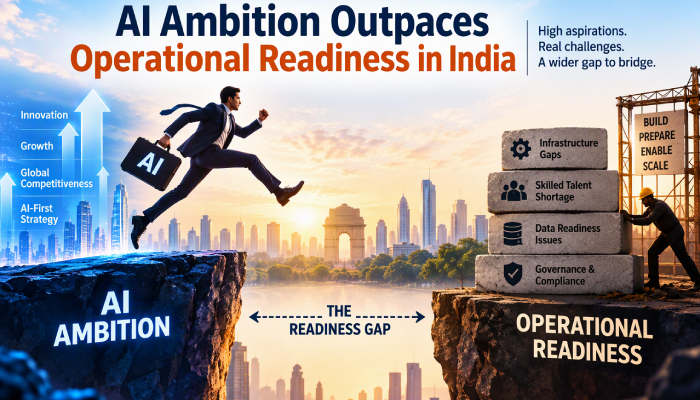
53% of Indian organisations identify AI, LLM and agentic workloads as a leading source of technology complexity, while data visibility, integration and cost pressures challenge enterprise adoption.
Indian enterprises are expanding their use of artificial intelligence, large language models (LLMs) and autonomous agents, but their operational capabilities are not advancing at the same pace. According to Dynatrace’s State of Observability 2026 report, gaps in visibility, data management and governance are emerging as significant barriers to scaling AI reliably.
Based on a global survey of 1,202 technology leaders, the report finds that 53% of Indian organisations identify the expansion of AI, LLM and agentic workloads as a leading source of technology complexity, up nine percentage points from the previous year. Meanwhile, 50% cite unpredictable AI behaviour as a major challenge, while 51% point to the growing complexity of technology environments.
The findings highlight a widening gap between AI ambition and what Dynatrace describes as operational proof: the ability to understand, validate and demonstrate what AI systems are doing, whether they are behaving as intended and the business value they deliver.
Visibility remains a critical weakness
As AI agents take on more responsibilities across enterprise environments, understanding how they make decisions is becoming essential to maintaining accountability and trust. However, the report identifies a significant gap between organisational priorities and current capabilities.
Globally, 43% of organisations consider understanding how AI agents reach decisions important, but only 27% currently address visibility into those decisions. Although 87% are using AI agents moderately or extensively in observability and IT operations, just 12% have achieved fully autonomous operations. Another 44% expect to reach that level within five years.
Human oversight remains central to this transition, with people continuing to verify an average of 66% of AI-powered decisions.
Data complexity and costs increase
The expansion of AI workloads is also increasing the volume of telemetry and the effort required to integrate and analyse data across distributed infrastructure.
In India, 45% of organisations identify telemetry volume as a source of complexity, up 10 percentage points year on year. Instrumentation complexity is cited by 53%, an increase of 21 percentage points, while 48% report integration challenges, up 13 percentage points. Another 44% identify data-ingestion costs as a major concern.
The global findings underline the financial implications. Some 81% of organisations report increased compute and infrastructure spending due to AI workloads, while 78% report higher energy costs. Additionally, 77% say AI workloads have increased their need for visibility into cost allocation.
The number of AI initiatives is also growing: 49% of organisations globally now run between six and 25 AI projects, compared with 42% a year earlier.
“Enterprises are accelerating AI adoption, but their ability to maintain visibility, trust and control over increasingly autonomous systems is struggling to keep pace.”
Reliability emerges as a key business outcome
Despite these pressures, Indian organisations are reporting measurable benefits from observability. Reliability and uptime are identified as important outcomes by 68% of respondents, up 16 percentage points. Better-informed decision-making is cited by 57%, an increase of 11 percentage points, while 41% point to improved capacity planning.
However, the wider operational benefits of AI remain uneven. Only 28% identify security remediation and 25% cite toil reduction as key areas of AI value, suggesting that many enterprises have yet to translate AI investments into broader operational efficiencies.
Security remediation presents another area for improvement. While 29% of Indian organisations report fixing vulnerabilities within 24 hours, only 21% have established a formal service-level agreement targeting remediation within that timeframe.
The findings suggest that scaling enterprise AI will require more than deploying models and agents. Organisations must strengthen observability, improve data integration, monitor infrastructure costs and establish clear accountability for AI-driven decisions. Without these foundations, growing AI adoption could add operational complexity faster than enterprises can manage it.