


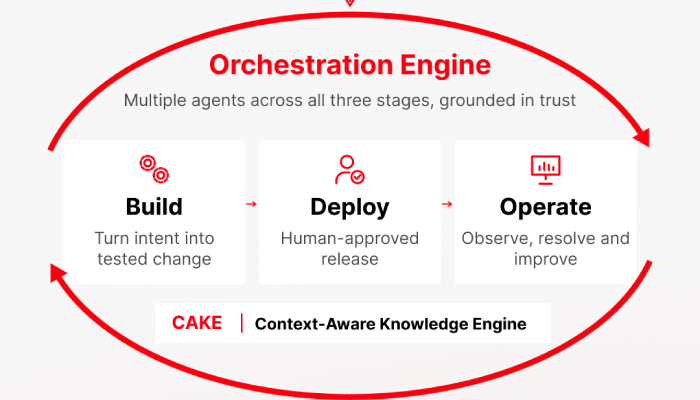
The unified product combines enterprise context, AI-agent orchestration and failure-conscious engineering to help organisations translate business intent into reliable outcomes across complex systems.
Hitachi Digital has launched HARC Compose, a unified product combining technology and services to help enterprises govern the full lifecycle of agentic engineering across complex, AI-driven environments. The platform is designed to carry enterprise-specific context, policies and business intent through software development, deployment, operations and continuous improvement.
The launch addresses a growing challenge in enterprise AI adoption: while AI agents can accelerate software development, faster code generation does not automatically translate into secure, reliable or measurable business outcomes. Without access to organisational knowledge, operational constraints, security policies and risk requirements, AI-generated changes can introduce new vulnerabilities and operational failures.
HARC Compose seeks to close that gap by coordinating AI agents across the build, deploy and operate stages, while retaining human oversight over critical decisions. Hitachi Digital’s forward deployed engineers (FDEs) use the platform to develop AI-native applications, oversee their deployment and continuously improve the performance of agents in production.
Anand Birje, CEO and Chairman of Hitachi Digital, said the product brings the company’s engineering and operational expertise together to help clients develop systems at AI speed while maintaining reliability in mission-critical environments. He described the integration of development and operations as a way to close the feedback loop between building software and delivering sustained business value.
A central component is the Context-Aware Knowledge Engine (CAKE), which connects enterprise intent with domain knowledge, systems, policies, security requirements, risks and production history. This context is made available to AI agents so they can generate outputs aligned with organisational requirements. The engine can also identify gaps and contradictions before agents act.
“Speed is expected in an era of AI-generated software; trust has to be earned. Customers need clarity on what a software change is meant to improve, proof that it worked, and confidence in the process behind it.” — Premkumar Balasubramanian, Chief Technology Officer, Hitachi Digital
The platform’s Orchestration Engine coordinates multiple agents across engineering and operational workflows. It supports different AI agents and tools selected by customers, including those operating in multi-vendor environments. This approach is intended to let organisations build on existing coding tools, AI frameworks and development environments rather than replace them.
HARC Compose also incorporates failure-conscious engineering. Using failure mode and effects analysis (FMEA), teams identify how proposed changes could fail and translate those risks into tests, controls and recovery strategies before release. Responsible AI capabilities are designed to guard against issues such as agent drift, while guided and autonomous work modes provide different levels of human involvement.
The product is built on Hitachi Digital’s Outcome-Forward Engineering (OFE) methodology, which treats Define, Build, Deploy and Operate as a continuous process. Under this approach, delivery is not considered complete when software is released; it is complete when the intended business outcome is achieved and sustained in production.
OFE rests on three principles: Fidelity, which establishes intent, constraints and risks before work begins; Throughput, which uses coding agents to accelerate implementation; and Trust, which verifies that the intended outcome has been achieved. CAKE connects these principles by providing agents with enterprise knowledge and relevant engineering history.
HARC Compose strengthens Hitachi’s HMAX portfolio, which brings AI capabilities to social infrastructure. It complements HMAX Foundry solutions, including HMAX Data Fabric, HMAX AI Operations and HMAX Cyber, supporting the development of secure AI agents and more stable autonomous operations.
Available worldwide, HARC Compose deployments supported by Hitachi Digital FDEs are already underway in the finance, healthcare and technology sectors. The company says the platform is designed to integrate with existing enterprise delivery, operations, governance and business intelligence systems.
For CIOs and technology leaders, the proposition is significant: enterprise AI governance must extend beyond model selection and experimentation to the changes agents make across business-critical systems. By linking organisational intent, engineering controls and production evidence, Hitachi Digital is positioning HARC Compose as a framework for making agentic engineering more accountable as enterprises move AI workloads into production.