



The Nielsen Annual Marketing Report 2026 points to a decisive shift towards experiential marketing, sports sponsorships and creator partnerships, even as gaps in cross-channel measurement raise questions about how brands will demonstrate returns.
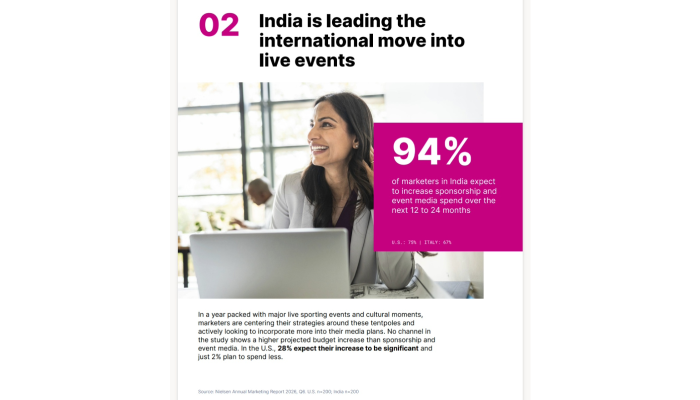
India is emerging as one of the world’s most aggressive markets for live-event and sponsorship-led marketing, with 94% of marketers planning to increase spending in these areas over the next 12 to 24 months. The finding, from Nielsen’s 2026 Annual Marketing Report, signals a significant shift in how brands are approaching audience engagement, with live experiences, sports properties and creator partnerships increasingly moving from experimental initiatives into core marketing budgets.
The report, titled Top 10 Signals Shaping Marketing Budgets in 2026, is based on a survey of 1,200 marketers across six markets: India, the United States, the United Kingdom, Italy, France and Germany. It examines changing investment priorities across advertising, sponsorship, sports, influencer marketing and artificial intelligence.
India’s projected increase in sponsorship and event media spending is the highest among the markets surveyed. The corresponding figures are 75% in the United States and 67% in Italy. More significantly, Nielsen reports that no other channel in the study records a higher projected budget increase. This positions India at the forefront of the global shift towards marketing strategies built around direct audience engagement and live experiences.
For India’s marketing industry, the trend reflects the growing commercial importance of major sporting competitions, entertainment properties, cultural events and business gatherings. Brands are increasingly looking beyond conventional advertising placements to create experiences that bring them closer to consumers, customers and professional communities.
The development also has implications for the business events ecosystem. Industry conferences, leadership forums, technology summits, partner engagements and sector-specific exhibitions are increasingly becoming part of the wider brand engagement strategy. For B2B marketers, such platforms offer opportunities to build relationships, demonstrate products, generate qualified leads and establish credibility with decision-makers. As budgets expand, the ability to connect event participation with measurable business outcomes will become a more important consideration.
Sports sponsorship becomes a strategic growth platform
The Nielsen findings indicate that sports sponsorship is increasingly being treated as more than a brand visibility exercise. Around 61% of Indian marketers describe sports sponsorship as a testing ground for reaching new audiences and entering new markets. The comparable figure is 54% in the United States, while Germany records 32%.
This suggests that marketers are looking at sports properties as platforms for market development, audience discovery and experimentation with new engagement models. India’s large and diverse sports audience, combined with the commercial reach of major tournaments and leagues, provides brands with opportunities to connect with consumers across age groups, regions and demographic segments.
“94% of marketers in India expect to increase sponsorship and event media spend over the next 12 to 24 months, making it the strongest growth signal across all markets surveyed.”
— Nielsen Annual Marketing Report 2026
Sports sponsorship also offers multiple engagement possibilities beyond traditional logo placement. Brands can activate campaigns through live experiences, digital content, athlete partnerships, social media interactions and audience-specific promotions. The combination of physical and digital engagement can extend the impact of a sponsorship beyond the event itself.
For marketers, however, the challenge is to understand which activities are generating genuine business value. Reach, impressions and visibility remain important indicators, but they do not necessarily establish whether a sponsorship has influenced consumer consideration, brand preference, purchase intent or customer acquisition.
The growing investment in sports and live events therefore makes stronger measurement frameworks essential.
Creator partnerships gain influence in India
Another major finding concerns the effectiveness of influencer and creator-led content. As many as 81% of Indian marketers rate influencer and creator content as very or extremely effective. This is 27 percentage points higher than the 54% recorded among US marketers, representing the widest effectiveness gap across the channels measured in the report.
The result reflects the expanding role of creators in India’s marketing ecosystem. Digital creators can connect brands with specific communities through content that is often more conversational, relatable and targeted than conventional advertising. Their influence extends across entertainment, lifestyle, technology, education, finance, travel and consumer products.
For brands, creator partnerships provide access to established audiences and communities that may be difficult to reach through traditional media alone. They also offer opportunities to develop content around specific products, services and consumer interests.
The growing confidence in creator marketing is likely to encourage brands to formalise influencer partnerships as a recurring budget category rather than treating them as occasional campaign experiments. This will also increase the need for more rigorous evaluation of creator selection, audience quality, engagement authenticity and campaign performance.
High perceived effectiveness, however, should not automatically be equated with measurable commercial return. Marketers need to distinguish between engagement metrics and outcomes such as qualified traffic, conversions, customer retention and revenue contribution. As creator spending grows, the ability to establish these connections will become increasingly important.
The measurement challenge behind rising budgets
While India’s marketers demonstrate strong confidence in live events and creator-led content, the report identifies a significant weakness in how marketing effectiveness is measured across channels.
Only 42% of Indian marketers say they measure return on investment holistically across traditional and digital media. The figure is 48% in the United States and 53% in Italy, making India the lowest among the markets highlighted in this comparison.
This gap raises an important question: if marketing budgets are increasingly distributed across events, sponsorships, creators, digital platforms, streaming and traditional media, how can organisations determine which investments are delivering the strongest returns?
The problem is that these channels frequently operate with different measurement methodologies. Digital campaigns may be evaluated through clicks, conversions and impressions, while live events are assessed through attendance, engagement, leads and sponsorship visibility. Creator campaigns may use views, reach and interactions, whereas traditional media often relies on audience ratings and estimated exposure.
When these measures remain disconnected, marketers risk evaluating individual activities in isolation rather than understanding their combined contribution to business performance.
For example, a consumer may encounter a brand through a sporting event, engage with a creator’s content, research the product through search and eventually complete a purchase through a digital platform or retail outlet. Measuring each interaction separately may fail to capture the cumulative influence of the campaign.
The report’s findings suggest that improving cross-channel measurement will be particularly important for India as investment in sponsorships, events and creators accelerates.
AI moves deeper into marketing operations
Artificial intelligence is another important theme in Nielsen’s assessment of changing marketing practices. The report points to the growing integration of AI into measurement and analytics, campaign evaluation and marketing decision-making.
Among US marketers, 75% use AI for measurement and analytics, making it their most common application. However, only 34% fully trust AI recommendations and act on them independently.
The distinction between adoption and trust is significant. While AI tools are increasingly being integrated into marketing workflows, organisations continue to evaluate the reliability of their recommendations and the quality of the data informing them.
AI can help marketers process large volumes of audience information, identify patterns, evaluate campaign performance and support budget allocation. It can also help bring together information from multiple platforms and channels, potentially making measurement faster and more comprehensive.
But the value of AI-driven marketing decisions depends on the accuracy and consistency of the underlying data. Incomplete audience information, inconsistent attribution models and fragmented reporting can limit the quality of AI-generated insights.
For marketers investing in increasingly complex campaigns, AI will therefore need to work alongside reliable measurement systems, rather than being treated as a substitute for them.
Search and measurement accuracy remain important
The report also highlights the continuing importance of search as a marketing channel. In the United States, the share of marketers rating search as very or extremely effective increased from 65% to 73%, representing the largest improvement among the channels assessed.
At the same time, 8% of US marketers report that they do not measure ROI at all on sponsorship, influencer and creator spending. This indicates that measurement gaps are not limited to emerging markets or specific marketing channels.
Accuracy is another priority. Around 44% of US marketers identify accuracy as the most important requirement from measurement technology. As marketing budgets become more diversified, reliable data and comparable performance indicators are becoming essential to investment decisions.
These findings reinforce a central challenge for the industry: marketers must be able to assess performance across an increasingly fragmented media environment without losing sight of the overall business objective.
Marketing budgets enter a new phase
The report also points to broader budget expansion across international markets. Around 81% of UK marketers expect their total advertising budgets to increase over the next 12 months, compared with 71% in the United States and 66% in Italy.
While the figures reflect different market conditions, they indicate that marketers in several major economies are preparing for continued investment. The combination of expanding budgets, growing interest in live experiences and wider adoption of AI suggests that marketing strategies are entering a more integrated phase.
For India, the 94% projection for higher sponsorship and event spending represents a particularly strong signal. It creates opportunities for event organisers, sports properties, media companies, technology providers, agencies and creators. At the same time, it raises expectations around accountability, audience quality and demonstrable returns.
The next phase of growth will depend not simply on how much brands spend, but on how effectively they connect different engagement channels and measure their contribution to business performance.
As Nielsen’s 2026 Annual Marketing Report makes clear, live events, creator partnerships and AI are becoming established components of marketing investment. The competitive advantage will increasingly belong to organisations that can combine the reach and engagement of these channels with accurate, unified measurement.
About the research
The Nielsen Annual Marketing Report 2026, titled Top 10 Signals Shaping Marketing Budgets in 2026, is based on a survey of 1,200 marketers, with 200 respondents each from the United States, United Kingdom, Italy, France, Germany and India. The full report is available at Nielsen’s website.
About Nielsen
Nielsen is a global audience measurement, data and analytics company. It provides independent intelligence on audience behaviour across channels and platforms to help clients understand, connect with and engage audiences worldwide.