



As enterprises move from data lakehouses to autonomous AI agents, CIOs must prioritise data quality, governance, metadata lineage and tested recovery mechanisms to ensure AI-driven decisions remain accurate, secure and reliable at scale.
Introduction
An AI agent can produce a confident answer while using the wrong version of a customer table. A retrieval system can cite a document that was valid yesterday but superseded this morning. In both cases the model may behave exactly as designed; the data foundation has failed. That distinction matters to CIOs moving from proof-of-concept demonstrations to systems expected to influence financial, operational and customer decisions.
After years of building data platforms, I distrust diagrams that end at “data available.” Availability is not fitness for use. Provenance, freshness, access rights and recovery behavior must be explicit and testable.
The lakehouse is a foundation, not a guarantee
A lakehouse can reduce unnecessary movement between analytical stores and offer open table formats, scalable processing and historical snapshots. It does not, by itself, settle whether a field means what an application assumes. Consider a metric called active_customer. Sales may define it by purchases in 90 days; support may define it by an open account. Combining both in a retrieval corpus without a contract produces plausible but inconsistent answers.
Govern the data product, not merely its storage: name an owner, define semantics, access policy, quality thresholds and update interval. A catalog entry alone is not evidence of trustworthiness.
Batch, CDC and streaming should coexist
Not every AI pipeline needs streaming. Financial close and historical model evaluation may suit scheduled batch; equipment alerts may demand low latency. Change data capture (CDC) publishes transactional changes without repeated full extracts.
Each path needs a stated correctness model. CDC requires attention to snapshot boundaries, source offsets and delete semantics. Streaming requires event-time handling, late-arrival policies and state recovery. Batch jobs need reproducible input windows and rerun behavior. When a customer record changes during a CDC snapshot, for example, a downstream consumer must not mistake an older snapshot value for the newest state. “Near real time” is not a substitute for documenting these cases.
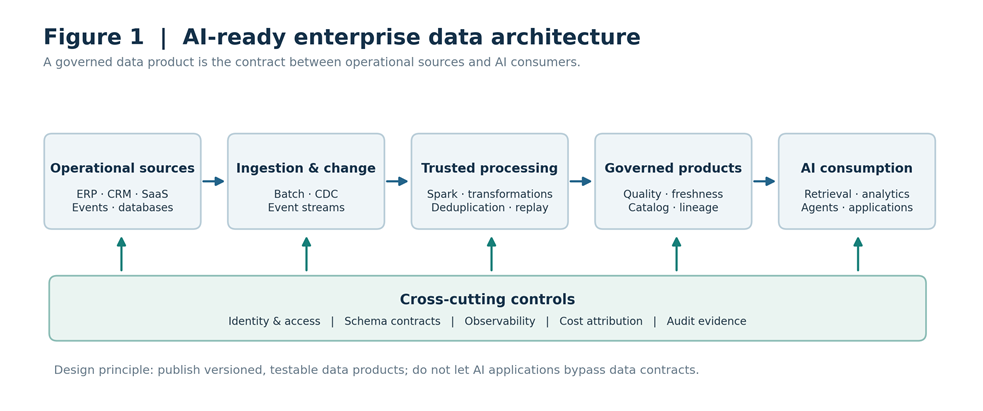
Spark performance begins with physical work
More Spark compute cannot rescue every poor plan. Inspect partition pruning, shuffle volume, skew, joins, file sizes and repeated scans before enlarging clusters. A query reading hundreds of unnecessary partitions remains wasteful on faster hardware.
For AI applications, this becomes a cost and reliability concern. Agents may generate SQL dynamically and retry failed calls. Apply query timeouts, read-only privileges where appropriate, concurrency controls and workload isolation. Measure bytes scanned and compute consumed per completed business task, not only the latency of an individual model response. Optimizing a prompt while ignoring an expensive warehouse scan misses the larger system.
Metadata and lineage become operational interfaces
Metadata is often treated as documentation maintained after delivery. AI systems make that approach untenable. Retrieval and agent workflows need to know which source is authoritative, what a field represents, when it was last refreshed and whether the requesting identity may use it. Lineage connects an answer back to source assets and transformations; it also helps engineers determine which downstream applications are exposed when a schema changes.
Useful lineage is not a decorative graph. It should identify the input version, transformation or job, output asset and relevant execution context. OpenLineage provides an interoperable event model for capturing aspects of this relationship. Organizations still need to decide what granularity is practical and which sensitive metadata must be restricted. For an agent response, I would retain the source asset, retrieval timestamp and policy version alongside the answer; a citation without version context can look authoritative while pointing to obsolete information.
Quality controls belong in deployment pipelines
A nightly dashboard may tolerate a missing optional column; an agent posting a financial adjustment should not. Release gates should check schema compatibility, key uniqueness, referential integrity, freshness and business rules. Streaming systems also need replay and duplicate-delivery tests.
A small illustrative example: a source changes an amount field from dollars to cents without changing its numeric type. Structural validation passes; business validation should fail. A contract can require an explicit currency unit and scale, with downstream consumers pinned to a version until they adapt. Quarantine suspect records when possible, and retain the reason rather than silently dropping them. These are familiar engineering practices, but AI increases the cost of overlooking them.
“Enterprise AI is only as dependable as the data foundation supporting it. Lakehouses and AI agents can deliver significant business value, but without trusted data, clear ownership, strong governance and verifiable lineage, even the most sophisticated AI systems can produce misleading outcomes. The real challenge for CIOs is not simply deploying AI, but building an enterprise data ecosystem that makes every AI-driven decision explainable, reproducible and trustworthy.”
Aditya Ranjan, Senior Data Engineer and Independent Industry Professional
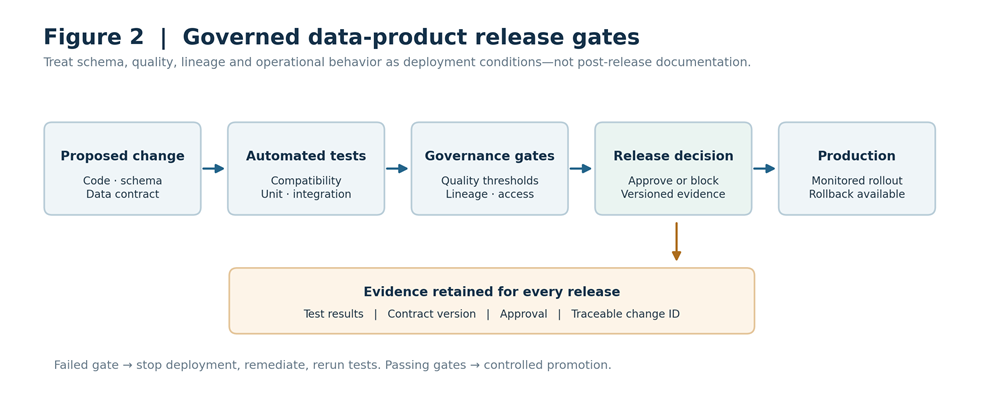
Governance must follow the identity and the decision
Governance must survive retrieval and tool execution. An agent must not gain broader warehouse privileges because a natural-language request sounds legitimate. Traces and prompts also need sensitive-data controls.
For consequential workflows, verification must be separate from generation. An agent reconciling revenue can propose an explanation, but the acceptance test should compare the result against authoritative records. For write operations, use approval steps, idempotency keys and audit trails. The NIST AI Risk Management Framework offers useful language for governing risks, although implementation choices must reflect the actual use case.
Measure the whole path, then test recovery
Track freshness, completeness, correctness, lineage coverage, query cost, recovery time and verified AI outcomes by workflow. A fast answer based on stale data is a failure. Platform-wide averages can hide high-risk exceptions.
Run a controlled exercise before launch: delay one source feed, introduce a compatible and an incompatible schema change, replay duplicate events and temporarily remove a downstream dependency. Confirm what the user sees, which alerts fire, whether the pipeline resumes correctly and how records are reconciled. Without failure testing, the design is an aspiration rather than a demonstrated operating model. Record the expected behavior and the actual outcome for each injected failure, then require remediation before approving a production release. A recovery claim without a repeatable test is only an assumption.
A practical roadmap for CIOs
Choose one high-value workflow. Map its path from source record to decision, assign data-product owners and publish contracts. Add quality gates and access controls before widening agent permissions. Compare cost and correctness over representative tasks, failures and retries.
No single platform makes an enterprise AI-ready. Durable advantage comes from defined semantics, known failure behavior and controls that remain effective as applications become autonomous.
An acceptance test for an AI-ready data product
For one customer-support knowledge workflow, I would write the acceptance criteria before connecting an agent. Every retrieved customer record must carry a source identifier, timestamp and permitted-use classification. The answer must cite the applicable record version, and the application must refuse to expose a restricted attribute to an unauthorized identity. A schema change should trigger a compatibility test rather than silently changing the meaning of a field. For auditability, record the test dataset version, expected result, responsible approver and the decision taken when a gate fails. In addition, log the acceptance-rule version so an apparent improvement cannot be explained by silently relaxing the test.
I would then test the same workflow with a deliberately stale source, an out-of-order CDC update and a temporary retrieval outage. The expected response is not always an answer: sometimes the correct behavior is to disclose that the source is outdated, return a partial result with a warning, or decline a high-impact action. Record the verified completion rate, stale-answer rate, p95 end-to-end latency and attributable processing cost. That combination gives business leaders a more defensible picture than model accuracy measured in isolation.
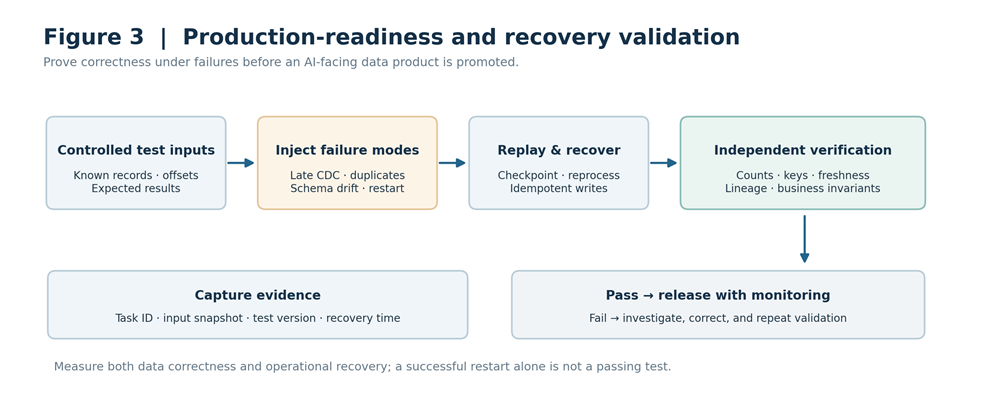
These tests do not require a proprietary platform. They require clear ownership, repeatable inputs and agreement on what a valid business outcome looks like. For CIOs, the question to ask at the investment gate is not simply whether the model works, but which data dependencies can invalidate its result and who is accountable for detecting that failure.
Conclusion
Enterprise AI succeeds when teams can explain and reproduce the path from source record to decision. Contracts, lineage, tested recovery and measurable quality are less visible than a model release, but they make AI dependable at scale.
Technical references
[1] Apache Spark. Structured Streaming Programming Guide. https://spark.apache.org/docs/latest/streaming/index.html
[2] Apache Spark. SQL Performance Tuning. https://spark.apache.org/docs/latest/sql-performance-tuning.html
[3] Debezium. Documentation: connectors, snapshots and change events. https://debezium.io/documentation/
[4] OpenLineage. OpenLineage Specification. https://openlineage.io/docs/spec/
[5] NIST. AI Risk Management Framework (AI RMF 1.0). https://www.nist.gov/itl/ai-risk-management-framework
[6] NIST. AI RMF Generative Artificial Intelligence Profile (NIST AI 600-1). https://nvlpubs.nist.gov/nistpubs/ai/NIST.AI.600-1.pdf
[7] FinOps Foundation. FinOps Framework. https://www.finops.org/framework/
Author biography
Aditya Ranjan is a Senior Data Engineer and independent industry professional with more than 16 years of experience architecting large-scale enterprise data platforms, governance frameworks, and AI-ready infrastructure in the United States. His expertise spans enterprise data architecture, distributed processing, data governance, metadata, and lineage. His technical writing examines how organizations can move from promising AI demonstrations to reliable production systems through measurable data quality, reproducible processing, and accountable governance. He writes about modern data architecture and enterprise AI from a practical engineering perspective, emphasizing trustworthy information, operational resilience, and scalable business capabilities. LinkedIn: https://www.linkedin.com/in/fnuadityaranjan