




As 85% of Indian organisations move AI beyond pilot projects and 60% report positive returns, Kyndryl’s 2026 Readiness Report highlights mounting challenges around cybersecurity, infrastructure, governance and organisational alignment.
Indian enterprises are beginning to see tangible returns from their investments in artificial intelligence, but the ability to sustain those gains is becoming a more complicated proposition. While AI adoption is accelerating across business operations, confidence in organisations’ ability to manage the associated risks is moving in the opposite direction. This divergence is emerging as one of the defining challenges of enterprise AI transformation.
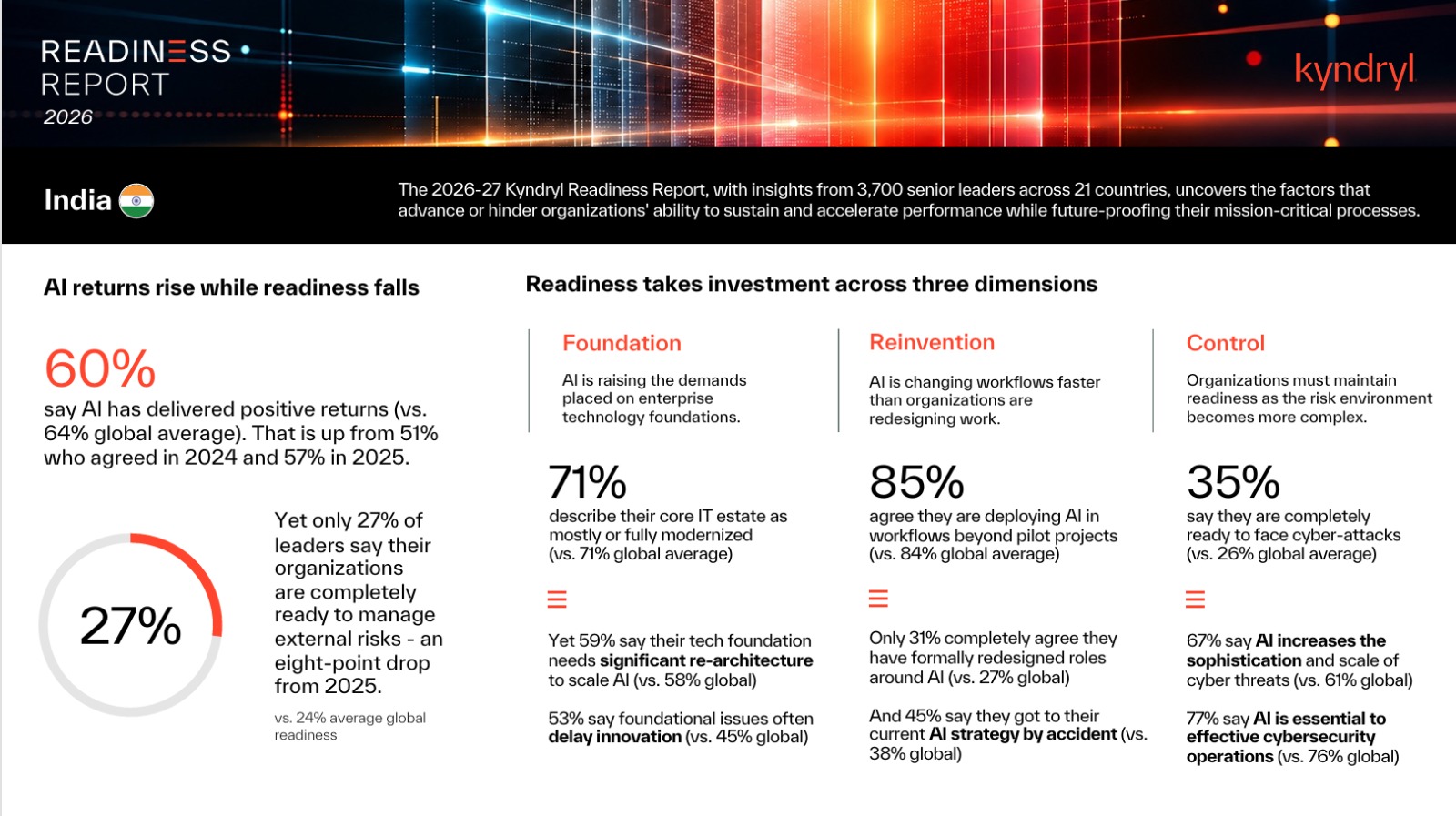
The third annual Kyndryl Readiness Report, based on responses from 3,700 senior business leaders across 21 countries, including 200 in India, captures this widening gap. It finds that 60% of Indian organisations investing in AI and machine learning report positive returns, an increase of three percentage points from 2025. Yet average readiness to manage external risks has fallen eight percentage points to just 27%.
The findings suggest that the central question for Indian businesses is no longer whether AI can deliver value. Increasingly, it is whether their technology foundations, people, operating models and governance structures can keep pace with the speed and scale of adoption.
India’s AI journey is moving beyond experimentation. According to the report, 85% of Indian organisations are deploying AI in workflows beyond pilot projects. At the same time, the proportion of organisations still in the experimentation stage has declined by 15 percentage points to 56%. The figures indicate that AI is becoming embedded in day-to-day business processes, rather than remaining confined to innovation teams and isolated proof-of-concept exercises.
However, adoption does not automatically translate into enterprise-wide transformation. Many organisations are discovering that successful pilots are easier to demonstrate than to scale, particularly when AI applications need to interact with legacy systems, fragmented data environments and established business processes.
The scaling problem: More pilots, fewer enterprise outcomes
The report identifies a significant gap between AI experimentation and operational deployment. Around 70% of Indian business leaders say their organisations have more AI pilots than they can realistically scale. Meanwhile, 58% say innovation frequently stalls after the proof-of-concept stage.
This suggests that enterprises are accumulating AI experiments without necessarily building the capabilities required to turn them into repeatable, measurable business outcomes. A successful pilot may demonstrate the technical feasibility of a use case, but scaling it requires a different level of investment and coordination. Data must be accessible and reliable, infrastructure must support the workload, security controls must be integrated, and employees must be prepared to work with AI-enabled processes.
The consequences are becoming visible in strategic decision-making. Half of the Indian organisations surveyed have significantly changed their AI strategy over the past year, while 31% have experienced an AI investment failure. These developments underline the uncertainty surrounding AI deployment, where technology choices, business priorities and implementation approaches are evolving rapidly.
Organisational alignment is another concern. The report finds that 37% of Indian organisations experience disagreement between their Chief Human Resources Officer and Chief Technology Officer or Chief Information Officer over AI strategy.
Such differences are significant because enterprise AI is not simply an IT deployment. It affects workforce structures, job responsibilities, skills, customer engagement and business processes. Technology leaders may focus on platforms, infrastructure, security and integration, while HR leaders are responsible for workforce readiness, talent development and organisational change. Without a shared approach, organisations risk building technically capable systems that employees are not equipped or prepared to use effectively.
Kyndryl Chairman and CEO Martin Schroeter describes this as a new kind of readiness gap. Organisations are moving quickly to capture AI opportunities, but the systems required to support those ambitions are not necessarily advancing at the same pace. He argues that attention to people, technology and governance will be essential to making early returns sustainable.
Cybersecurity: AI improves detection, but response readiness weakens
Cybersecurity remains the most prominent external risk confronting organisations. For the third consecutive year, security concerns topped the list of external risks identified by Indian leaders. More significantly, confidence in the ability to manage cyberattacks has declined.
Only 35% of Indian organisations say they are completely ready to manage cyberattacks, down 10 percentage points from the previous year. The global figure is even lower at 26%, representing an 11-point decline.
This is a concerning development at a time when enterprises are expanding their digital footprints and connecting AI applications to increasingly sensitive business systems. AI adoption can create new pathways for attackers, particularly when models, agents and automated workflows are given access to enterprise data, applications and privileged systems.
The challenge is not limited to conventional cyber threats. Organisations must also consider the security implications of AI-generated content, automated decision-making, data leakage, compromised credentials and the potential misuse of AI agents. As these systems become more deeply integrated into business operations, a security incident can have consequences that extend beyond an individual application.
There is, however, an apparent contradiction in the findings. Three in four business leaders say AI helps their organisations identify threats faster, even as confidence in their ability to respond to cyberattacks has declined.
The distinction between detection and response is critical. AI can analyse large volumes of data, identify unusual patterns and help security teams prioritise potential threats. But detecting an attack is only one part of an effective security strategy. Organisations also need the processes, skilled personnel, incident-response capabilities and governance structures to contain threats and recover operations.
The findings point to a growing need to move beyond deploying AI-powered security tools towards building a more comprehensive cyber-resilience framework. This includes securing the infrastructure on which AI runs, controlling access to data and systems, monitoring automated activity and ensuring that security teams can act quickly when threats are identified.
AI is challenging established business models
The impact of AI is extending beyond technology departments and operational efficiency. It is beginning to challenge established industry boundaries, commercial models and competitive assumptions.
The Kyndryl report identifies competitive disruption outside organisations’ traditional industries as another major concern. Globally, readiness in this area declined by 10 percentage points from 2025 to 23%. The concern reflects the growing influence of AI agents and other emerging technologies that enable companies to enter markets, automate services and compete in areas previously dominated by established players.
The change is already visible in enterprise operations. The report finds that 80% of Indian organisations are using AI agents to automate workflows that previously required coordination across multiple teams or systems.
This development has implications for how businesses create and deliver value. AI agents can connect processes, retrieve information, execute tasks and coordinate activities with limited human intervention. As organisations deploy these capabilities, traditional assumptions about the division of work between departments, service providers and customers are likely to change.
Retailers, for example, must consider how to benefit from AI-powered shopping assistants without losing direct relationships with customers. If consumers increasingly rely on AI tools to discover, compare and purchase products, retailers may have to rethink how they maintain brand visibility and customer loyalty.
Software companies face a different challenge. As generative AI makes it easier for organisations to build customised applications and automate development tasks, the traditional software-as-a-service model may come under pressure. Enterprises could reassess the balance between buying packaged software and developing tailored solutions using AI.
Financial institutions are also facing questions about emerging lending models and new forms of competition. AI-enabled analysis and alternative approaches to assessing risk could change how financial services are designed and delivered.
For business leaders, these developments make AI strategy a competitive issue rather than simply a technology investment. Organisations must evaluate not only how AI can improve existing processes but also whether it could undermine the assumptions on which their current products, services and revenue models depend.
Modern infrastructure does not automatically mean AI readiness
Infrastructure modernisation remains a priority for Indian enterprises. For the third consecutive year, leaders identified upgrading IT infrastructure as the most important action their organisations are taking to mitigate external risks.
The report finds that 71% of Indian leaders consider their infrastructure mostly or fully modernised. Yet 59% say significant re-architecture is still required to support AI at scale.
This apparent contradiction highlights an important distinction: an infrastructure environment that is modern by conventional IT standards may not necessarily be designed for the demands of enterprise AI.
AI workloads can place different demands on computing capacity, data access, storage, networking and application architecture. They also require organisations to integrate information from multiple systems while maintaining appropriate controls over data quality, privacy and security. Existing infrastructure may support traditional enterprise applications effectively but struggle to accommodate the scale, speed and complexity of AI-driven workloads.
The need for re-architecture also reflects the challenge of integrating AI into legacy environments. Many organisations operate a combination of cloud platforms, on-premises systems, older applications and distributed data repositories. Making AI work across these environments requires more than adding computing resources. It involves rethinking how systems communicate, how data is managed and how applications are designed.
Enterprises therefore need to assess infrastructure readiness against actual AI requirements rather than relying solely on broad modernisation benchmarks. The objective should be to create an environment that can support AI workloads securely and reliably while allowing organisations to scale successful applications without repeatedly rebuilding their technology foundations.
“AI ambitions are moving faster than the systems needed to support them, and the bar for readiness keeps moving as AI becomes more integrated in enterprises.”
— Martin Schroeter, Chairman and CEO, Kyndryl
The people and governance dimension
The report’s findings also reinforce that AI readiness cannot be measured only through technology investments. Workforce capabilities, leadership alignment and governance are equally important.
As AI moves into operational workflows, employees need to understand how to use these tools, interpret their outputs and recognise when human judgement is required. Organisations must also define accountability for decisions influenced or executed by AI systems. This becomes particularly important when agents are authorised to interact with business applications or perform tasks across multiple systems.
The disagreement between HR and technology leadership reported by 37% of Indian organisations suggests that some enterprises have yet to establish a common understanding of how AI will reshape work. A technology-led deployment without a corresponding workforce strategy can create resistance, skills gaps and uncertainty over responsibilities.
Governance must also evolve alongside adoption. Organisations need clear policies covering data access, model usage, human oversight, accountability and risk management. These policies should be embedded into operational processes rather than treated as separate compliance exercises.
A sustainable AI strategy therefore requires collaboration among CIOs, CTOs, CISOs, CHROs and business leaders. Technology teams must provide secure and scalable platforms; security teams must assess emerging risks; HR must prepare the workforce; and business leaders must ensure that AI investments are tied to measurable organisational priorities.
From AI adoption to enterprise resilience
The Kyndryl Readiness Report presents a picture of an Indian enterprise landscape that is making meaningful progress in AI adoption but is still working through the complexities of large-scale deployment. Positive returns are increasing, AI is moving into business workflows, and AI agents are beginning to automate activities that previously depended on coordination across teams and systems.
Yet the decline in external-risk readiness indicates that the foundations supporting this transformation remain under pressure. Cybersecurity confidence is weakening, infrastructure requires further re-architecture, business models face disruption and leadership teams are not always aligned on the implications of AI.
The challenge for enterprises is to close this gap before the complexity of AI adoption outpaces their ability to manage it. That means shifting the focus from the number of pilots launched or tools deployed to the quality of outcomes delivered, the resilience of supporting systems and the organisation’s ability to adapt.
For Indian businesses, the next phase of AI maturity will depend on connecting three priorities: technology that can scale, people who can use and govern it effectively, and security frameworks capable of managing the risks that accompany greater automation.
The 60% reporting positive returns provide evidence that AI investment is beginning to pay off. But the 27% average readiness figure is a warning that those returns cannot be taken for granted. The organisations most likely to sustain their advantage will be those that treat AI not as a collection of standalone projects, but as an enterprise-wide transformation requiring infrastructure renewal, workforce readiness, strong governance and continuous risk management.