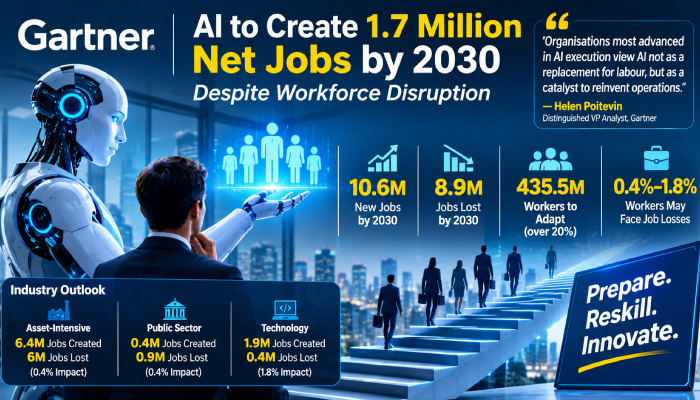
AI is forecast to generate 10.6 million jobs and eliminate 8.9 million globally, while more than 435 million workers will need to adapt to changing roles.
Artificial intelligence is expected to create a net 1.7 million jobs worldwide by 2030, generating 10.6 million new positions while eliminating 8.9 million, according to a forecast by Gartner. The projections challenge concerns that AI will trigger widespread job losses, but point to significant changes in how work is organised and performed.
Gartner estimates that between 0.4% and 1.8% of global workers will experience job losses directly attributable to AI by 2030. However, the larger impact will be job transformation: more than 435.5 million employees, or over 20% of the global workforce, will need to adapt to changes in their responsibilities, working methods and roles.
The disruption is already influencing recruitment. Gartner estimates that business and IT executives deferred the creation and hiring of 1.3 million positions in 2026. By 2030, approximately five million people will have experienced delayed hiring as organisations postpone creating new roles.
“Organisations most advanced in AI execution view AI not as a replacement for labour, but as a catalyst to reinvent operations and rebalance workforce and technology capabilities.”
— Helen Poitevin, Distinguished VP Analyst, Gartner
“Deferred jobs are not the same as lost jobs. They simply aren’t created,” said John Lovelock, Distinguished VP Analyst and Chief of Research at Gartner.
The impact will vary significantly across industries. Asset-intensive sectors are forecast to create 6.4 million jobs and lose six million by 2030, while the public sector could gain 400,000 jobs but lose 900,000. Technology is expected to see 1.9 million new positions and 400,000 job losses, although AI-related job losses could affect 1.8% of its workforce.
Gartner cautions against applying a uniform workforce strategy across industries, as AI exposure, skills requirements and operational challenges differ.
The findings suggest that the central workforce challenge is not simply job elimination, but preparing employees for changing roles. Organisations will need to combine AI adoption with workforce reskilling, redesigned operating models and investment in new capabilities to translate productivity gains into sustainable business value.